How to Choose a Bike Helmet: Fit, Safety and Comfort
A practical guide to choosing a bike helmet: getting the fit right, UK safety standards, ventilation, straps and when to replace a worn shell.
The short answer
A bike helmet only protects you properly if it fits, so start with your head measurement and work backwards from there. The right helmet sits level and low on your forehead, stays put when you shake your head, and leaves no pressure points after ten minutes of wear. Colour, price and vent count all come after that.
In practice, that means measuring your head circumference, choosing a shell whose size range covers that number comfortably, and being willing to try two or three models before you find the shape that suits your head. Every helmet sold in the UK has to meet the same minimum impact standard, so a cheaper helmet is not automatically a less safe one — it is usually just heavier, hotter or less adjustable.
Before you start: what you need
You need very little to do this well, but the small things matter. Have your measurement ready before you look at any helmet, and know roughly what kind of riding you do, because that decides coverage and ventilation before anything else.
- Tape measure
- A soft tailor's tape, or a piece of string and a ruler
- Typical adult size ranges
- Around 52–56 cm, 55–59 cm and 58–62 cm, depending on the model
- Standard to look for
- BS EN 1078, the pedal cycle helmet standard used in the UK
- Finger gaps to check
- Two fingers between eyebrows and shell edge, one to two under the chin strap
- Time needed
- About 15–20 minutes to measure, try on and set the straps properly
If you are choosing for a child, bring them with you and measure their head on the day — children's head sizes change quickly and a helmet bought a size up will not sit correctly.
How to choose a bike helmet in 7 steps
-
Measure your head circumference
Wrap a soft tape around your head about 2 cm above your eyebrows, keeping it level and just above the ears. No tape? Run a piece of string around, mark it, then measure the string against a ruler. Write the number down in centimetres — you will use it for every helmet you consider.
-
Find the size range that contains your measurement
Helmets are sold in ranges rather than single sizes. Aim for the middle of a range, not the edge: if you measure 56 cm, a 55–59 cm shell leaves the retention dial room to work, while a 52–56 cm shell is already at its limit. Many models also come with interchangeable pads to fine-tune the fit.
-
Match the shell to your riding
Decide this before you try anything on, because it narrows the shelf quickly. Town and commuting helmets usually offer deeper rear coverage and reflective details; road helmets trade some coverage for airflow; mountain bike helmets add a peak and a lower rear shell for trail riding.
-
Try it on and set the retention dial
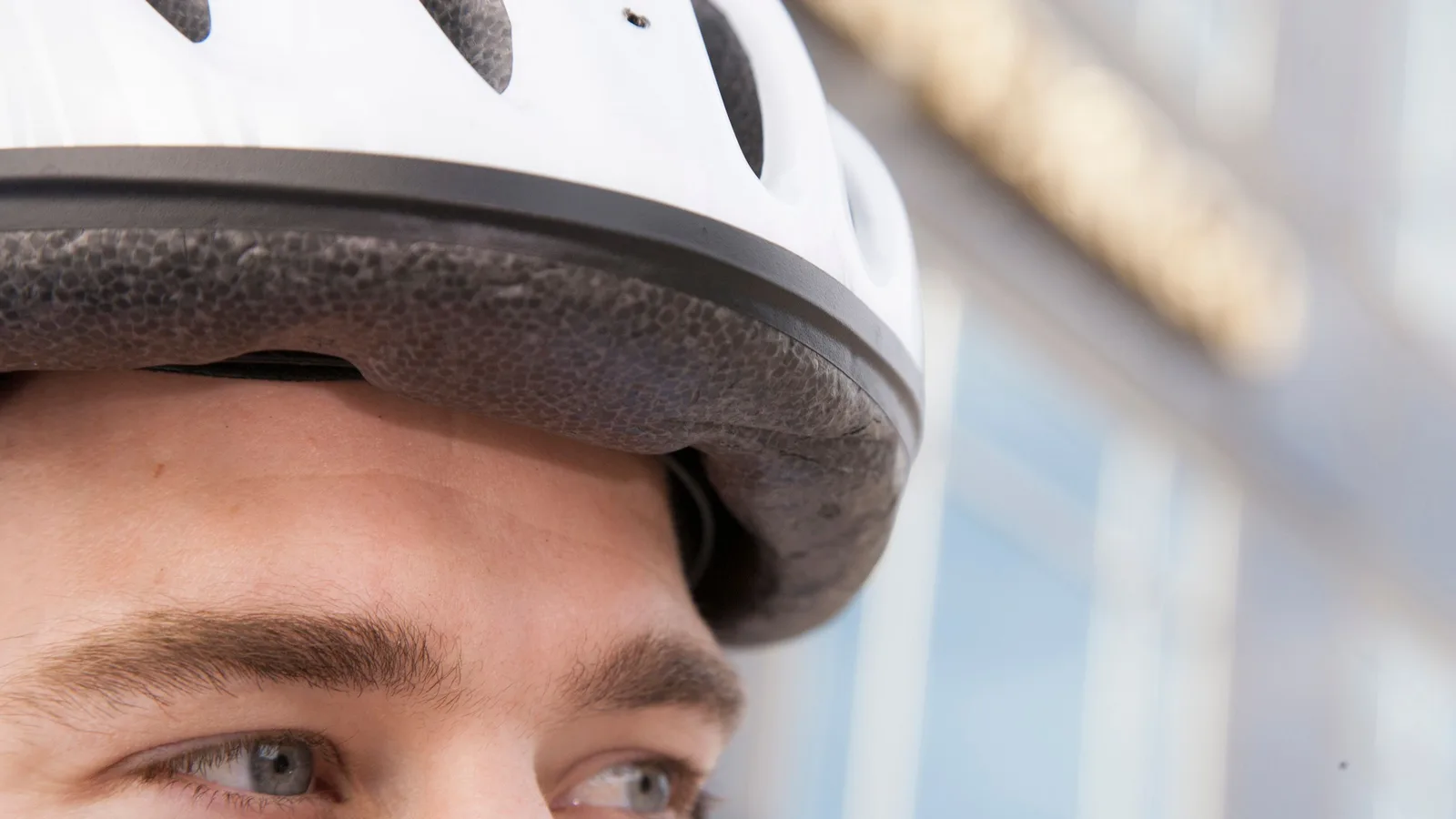
Put the helmet on with the dial fully loosened, then tighten until the shell grips without pinching. The front edge should sit about two fingers above your eyebrows and the helmet should feel level, not tipped back like a sun hat. If you feel pressure at the forehead or temples within a minute, that shell shape is wrong for you — try another model rather than another size.
-
Set the straps into a V under each ear
Slide the splitter on each side so the straps form a neat V just below your earlobe, then set the chin strap so one to two fingers fit under the buckle with your mouth closed. Open your mouth wide: the strap should pull gently down against your chin. Too loose and the helmet can roll off in a fall; too tight and you will stop doing it up on longer rides.
-
Run the shake, roll and vision tests
Shake your head firmly side to side and up and down. A well-fitted helmet moves with your scalp and settles back; one that slides independently or lifts at the front is too loose. Push the front of the shell up and back with your hand — it should not roll clear of your forehead. Then check that the front edge does not block your view in a riding position and that you can still glance over your shoulder.
-
Check the standard and re-check after a week
Look inside the shell for the standard marking, along with the manufacturer, model and size, and keep the labels and receipt. After a week of riding, re-tighten the dial and re-set the straps — padding compresses and straps bed in, so a helmet that felt snug in the shop often loosens off.
Head shape, hair and glasses: the details that decide comfort
Once the size is right, comfort comes down to shape and to what you wear with the helmet.
- Round versus oval shells. Some helmets are rounder, some longer front to back. Pressure at the forehead and back of the skull usually means the shell is too round for you; pressure at the temples means the opposite.
- Long hair. Look for a helmet with a gap or cradle designed for a ponytail, or wear hair low at the nape rather than in a high bun that pushes the shell up.
- Glasses and sunglasses. The arms should sit outside the straps, not trapped underneath, and the strap splitter should not press the arms into your head.
- Hearing aids and headphones. Route the straps so nothing sits on the device, and avoid anything that blocks traffic noise.
- Children. Buy the size that fits today. A helmet that is a size too big slides forward over the eyes and offers poor protection.
Match the helmet to how you ride
| Feature | Road | Commuter | Mountain bike |
|---|---|---|---|
| Coverage | Sits higher, with minimal rear coverage | Deeper at the back, covering more of the skull | Extends lower at the back and around the temples |
| Ventilation | Large vents designed for airflow at speed | Moderate vents with internal channelling | Fewer, wider vents, often with mesh over the openings |
| Peak or visor | Usually none | Short brim or none | Long, adjustable peak |
| Typical extras | Lightweight retention systems and aero shaping | Reflective panels and mounts for a rear light | Goggle clip and a tougher outer shell |
| Suits | Fast road riding and long distance | Daily commuting and town riding | Trail centres and technical off-road riding |
If you ride several ways, choose for the riding you do most often. A commuter helmet with a removable peak covers town riding, light trail use and most family rides, which is why it is the most common choice for UK riders who only own one helmet.
Safety standards: what the labels mean
In the UK, pedal cycle helmets are expected to meet BS EN 1078. The marking is printed on a label inside the shell, alongside the model name and size. That label is your evidence that the helmet has passed the minimum impact tests for its category — it is not a rating, and helmets are not graded from one star to five.
Rotational-impact liners, the slip-plane systems built into some helmets, are designed to reduce rotational forces in an angled impact. They are a reasonable extra, but they sit on top of a good fit rather than replacing it.
Ventilation, weight and comfort
Vent count is a poor way to compare helmets. What matters is how the air channels run through the shell and how fast you ride: a heavily vented road helmet works at 20 mph and does very little when you are crawling through traffic, while a commuter helmet with fewer, deeper channels can be cooler on a slow ride.
Weight varies widely between models, and a heavier helmet is not a less safe one — but you feel the difference on a long ride and on your neck at the end of it. Padding quality matters just as much: thin, firm pads suit riders who sweat heavily, while thicker pads feel plusher and compress over time.
The trade-off of buying online
Why online works
- Far more sizes, colours and shell shapes in one place
- You can compare size charts and standards labels calmly at home
- The full specification is written down before you commit
What you give up
- You cannot feel pressure points before you pay
- A return adds a week when the shape turns out to be wrong
- Setting up the straps and retention dial is entirely your job, with no one to check it
If you buy without trying first, measure carefully, order from a shop with a straightforward returns policy, and test the fit indoors with the labels intact so you can send it back if the shape is wrong.
When to replace a helmet
- After any impact. Replace a helmet that has hit a road, a kerb or a hard floor, even if there is no visible damage. The foam compresses once and does not spring back.
- After a fall where the helmet took the landing. The same rule applies whether or not you were hurt.
- Every few years in normal use. Many manufacturers suggest replacing a helmet every three to five years, because foam, adhesives and straps degrade with sweat and sunlight.
- At the first sign of failure. A rattling shell, cracked foam, frayed straps, a sticky retention dial or a buckle that will not hold are all reasons to stop using it.
- When it no longer fits. A child's helmet outgrown, or a helmet that only fits when the dial is at its limit, needs replacing.
Common mistakes and how to fix them
- Buying by hat size or clothing size. Helmet sizing is not the same as anything else you wear. Fix: measure your head with a tape.
- Sizing up for a child to grow into. A loose helmet slides over the eyes and will not protect the front of the head. Fix: buy the size that fits now and check quarterly.
- Wearing it tipped back. A helmet worn like a sun hat leaves the forehead exposed. Fix: bring the front edge down to about two fingers above the eyebrows, then reset the dial and straps.
- Leaving the strap loose or undone. An undone strap lets the helmet leave your head in a fall. Fix: set the chin strap so one to two fingers fit under the buckle, every ride.
- Keeping a helmet after a crash. Fix: retire it, and cut the straps so nobody else picks it up thinking it is safe.
- Ignoring pressure points. A helmet that pinches gives you a headache and makes you loosen it. Fix: change model or shell shape, not just size.
Frequently asked questions
How tight should a bike helmet be?
Snug enough that the shell moves with your scalp when you shake your head, with no pressure points. The retention dial should need a firm turn to close, and you should fit one to two fingers under the chin strap — no more.
Is a more expensive helmet safer?
Not automatically. Every helmet sold in the UK has to meet BS EN 1078, so all of them pass the same minimum impact tests. Spending more usually buys lower weight, better airflow, easier adjustment and a nicer finish; the fit you achieve matters more than the price.
Can I wear a cycling cap under my helmet?
A thin skull cap or cycling cap is fine and useful in cold or wet weather, but a thick beanie lifts the shell off your forehead and changes the fit. If you plan to wear something underneath regularly, fit the helmet while wearing it.
How long does a bike helmet last?
Many manufacturers suggest replacing a helmet every three to five years, because foam and adhesives degrade with sweat, sun and use. Replace it straight away after any impact, and as soon as you see cracks, a loose shell or compressed foam.
Do children need a different helmet standard?
Children's cycling helmets normally carry BS EN 1078, the same as adult ones. Helmets made for very young children may instead be built to EN 1080, which includes a breakaway strap design to reduce strangulation risk — check the label inside the shell.